
Why Sugar Keeps Winning Even When You Know Better
How mindset beats systems, and systems beat willpower.


We put sugar in baby formula, feed it to kids at every birthday party, stock it in hospital vending machines, and then act surprised when nobody can stop eating it.
Sugar is a subject I’ve been studying closely for years, because I’ve struggled with it myself. And the more you look into it, the harder it is to know what’s actually true, because both sides cherry-pick their evidence and present it as the whole story.
On one end, you have people claiming it all comes down to calories and sugar is basically harmless. A nutrition professor at Kansas State ate nothing but Twinkies, Doritos, and Oreos for 10 weeks, lost 27 pounds, and saw his cholesterol improve. Case closed, right? On the other end, you have people claiming sugar is the single most destructive substance in the modern diet, responsible for 2.2 million new type 2 diabetes cases and 1.2 million new cardiovascular disease cases globally in a single year, from sugar-sweetened beverages alone. Both sides wave their evidence around like it settles the debate. Neither side is lying, and neither side is telling you the whole story.
The conversation swings between these extremes, and most of the content in between just repeats the same advice: sugar is bad, eat less.
This article asks a different question: what systems are already running inside your life that make sugar consumption effortless and automatic?
You didn’t build them on purpose. Nobody sat down and designed a sugar routine. But the routines are there: the 3pm desk snack, the post-dinner treat, the drive-through on the way home, the reward after a hard day. These patterns formed without your input, reinforced by an environment that treats sugar consumption as completely normal, and now they run on autopilot.
The more I dig into the research, the more a hierarchy keeps showing up: mindset beats systems, and systems beat willpower. Not because willpower is worthless, but because willpower depletes. Systems operate automatically. And mindset determines which systems you build in the first place.
That hierarchy is the throughline of everything that follows.
A Quick Note on What This Is (and Isn’t)
No sugarcoating here. This is what I call a Firehose article: my attempt to lay out the entire landscape of sugar in one place. The neuroscience, the industry playbook, the hidden damage, a genuine paradox in the research that most articles ignore, and a reframe that changes the whole conversation. Each section could be its own deep-dive later.
I’m a National Board Certified Health and Wellness Coach, not a physician. What I do is connect dots across research, coaching experience, and conversations with experts, then lay it out so you can make your own decisions. This article is for educational purposes only and does not constitute medical advice. Always consult your healthcare provider before making changes to your diet or health routine. If you’ve ever felt like you “should” be able to handle this but can’t, the problem has never been you, it’s what you can’t see. Let’s start naming it.
What’s in this article:
The Reward System Hijack -How sugar rewires your dopamine receptors and turns your 3pm snack into a conditioned reflex
The Comfort Food Trap -Why sugar actually works as stress relief, and why that makes everything worse
The Gut Signal You Can’t Override -Three systems pushing you toward sugar without your permission
The Environment Is Not Neutral -Hidden label names, vanishing caloric density, and algorithmic targeting
The Playbook That Built the Perception -How sugar industry tactics became Big Tobacco’s playbook
The 7-Week Illusion -Your blood work looks fine while liver fat accumulates silently
What’s Happening Upstairs -Sugar impairs the brain region you need for self-control
Why “Cutting Back” Makes It Worse -The ironic cognitive processes that turn restriction into obsession
Mindset Literally Rewires the Reward System -The research evidence that your framing determines whether change sticks
PART 1: The Invisible Systems
The Reward System Hijack
You’ve probably heard the comparison: sugar lights up the same brain pathway as cocaine. It gets thrown around so often that it’s easy to dismiss. But the mechanism behind it is worth understanding, because it explains something most people experience but can’t name.
Sugar triggers dopamine release in the nucleus accumbens, the brain’s reward center, hijacking the same core circuitry as drugs of abuse and driving compulsive, habit-driven eating behaviors. Over time, chronic sugar intake downregulates D2 dopamine receptors, which is the biological basis of tolerance: you need progressively larger hits of sweetness to get the same reward response. Your brain literally turns down the volume on pleasure to cope with the constant signal.
On top of that, sugar triggers the release of endogenous opioids, and when intake drops, the withdrawal symptoms parallel opiate withdrawal, including anxiety, aggression, and tremors.
This is happening in everyone who eats sugar regularly. The question isn’t whether the pathway is running. The question is what keeps triggering it, because it’s probably not what you think.
The Cue You Don’t Notice
Think about your 3pm routine at work. Maybe there’s a snack drawer, a vending machine walk, a specific chair where you always eat something sweet. You probably think of that as a choice. Here’s what the research says it actually is.

Environmental cues, things like the smell of a bakery, a specific location, or a time-of-day routine, set off what researchers call cephalic-phase physiological responses: your heart rate shifts, you salivate, dopamine fires. You experience all of that as a “craving,” but the mechanism is classical conditioning. Dopamine enhances the saliency of these cues, strengthening the association every time the loop runs.
Behavioral economics research consistently shows that simply moving a candy bowl from a desk to a drawer drastically reduces consumption. Visibility alone, not hunger, drives the behavior. Once you see the 3pm snack as a conditioned reflex rather than a decision, the next system makes even more sense.
The Comfort Food Trap
Most people have had the experience of reaching for something sweet after a stressful day. There’s a reason that works, and it’s not just in your head.
Sugar temporarily blunts the stress response by reducing adrenocorticotropic hormone (ACTH) and cortisol. That’s the “comfort food” mechanism, and it genuinely works in the moment. The problem is that chronic sugar consumption dysregulates the hypothalamic-pituitary-adrenal (HPA) axis, chronically elevating baseline cortisol and driving long-term anxiety and depressive behaviors.
So the thing you’re using to manage stress is making you more stressed. You just can’t feel it because the relief is immediate and the damage is delayed by weeks or months. And while your conscious brain is busy running those two loops (the reward chase and the stress relief), there’s a third system operating even deeper, one you have no conscious access to at all.
The Gut Signal You Can’t Override
This is the one that changed how I think about cravings. It turns out your gut isn’t just digesting sugar. It’s actively lobbying your brain for more of it.
Sugar-driven changes in the gut reduce short-chain fatty acid production, increase intestinal permeability, and trigger inflammatory signals through the gut-brain axis. Fructose specifically destroys tight junctions in intestinal epithelial cells by depleting their ATP, creating the “leaky gut” that allows bacterial endotoxins into circulation.
Meanwhile, sugar simultaneously triggers dopamine release in the nucleus accumbens while delaying the acetylcholine satiety signal that tells you to stop eating. Your gut is inflamed and leaking, and your brain isn’t getting the “full” signal. Both systems are compromised at the same time.
And then there’s the Protein Leverage Hypothesis: when your diet is diluted by refined carbs and fats (which is exactly what ultra-processed food does), your brain demands more total food to meet its amino acid requirements, a mechanism confirmed in a randomized human trial. Three systems, all pushing in the same direction, none of which require your conscious participation.
Those internal systems would be hard enough to override on their own. But they don’t operate in a vacuum.
The Environment Is Not Neutral
Walk into any grocery store and try to avoid sugar. Here’s what you’re up against: high-fructose corn syrup (HFCS) ratios are deliberately unlabeled on packaging, and manufacturers use higher fructose-to-glucose ratios for more sweetness at lower cost without disclosing it to consumers. Sugar shows up under dozens of different label names, and the average shopper has no way to track total intake across products.

The engineering goes beyond ingredients. Food is designed with vanishing caloric density (it melts in your mouth, bypassing satiety signals) and dynamic contrast (a crunchy shell around a creamy center that drives repetitive eating). And it doesn’t stop at the store. Online platforms use algorithmic microtargeting to push hyper-palatable foods to the demographics most likely to respond.
Dr. Suneel Dhand , a guest on Healthy & Awake Podcast, put it simply:
“Is what I’m eating something my great-grandmother would have eaten?”
That question cuts through all of it. The grocery store, your phone, and your social media feed are all optimized for the same outcome, and it isn’t your health.
A dopamine system that builds tolerance. Conditioned cues firing automatically. A stress loop that feeds itself. Gut signals you can’t feel. And an environment engineered to keep all of it running. If you’re thinking “no wonder I can’t stop,” that reaction makes sense given everything you just read.
But here’s where the story takes a turn, because the feeling that this is impossible? That was manufactured too.
PART 2: The Manufactured Difficulty
“It’s Not Heroin Withdrawal”
Ask someone who’s tried to quit sugar what it was like, and you’ll hear words like “impossible,” “torture,” “I lasted three days.” The language people use makes it sound like kicking a hard drug. And the neurochemistry from Part 1 is real: chronic sugar intake genuinely downregulates D2 dopamine receptors, conditions reflexive craving through classical conditioning, and dysregulates the HPA axis. Research confirms that sugar withdrawal produces anxiety, aggression, and tremors that parallel opiate withdrawal, and that intermittent sugar intake creates endogenous opioid dependence with symptoms qualitatively similar to morphine or nicotine withdrawal.
But the comparison has a ceiling: those symptoms peak and then subside. The constant reinforcement from stores, ads, screens, and social cues amplifies the noise until the signal (that you’d actually be fine without it) is impossible to hear.
The perceived impossibility is the manufactured part. The neurochemistry is real, the withdrawal is real, but the feeling that this is something you can’t survive? That feeling has been amplified far beyond what the biology warrants. And the amplification has a history.
The Playbook That Built the Perception
That perception of impossibility didn’t appear out of nowhere. Someone built it, and the history is anything but sweet. The sugar industry pioneered science-manipulation tactics in the 1940s that were later adopted by the tobacco industry. Robert Hockett served as the Sugar Research Foundation’s science director from 1943 to 1953, then moved to tobacco’s Tobacco Industry Research Committee, saying the sugar crisis was “so similar” to what tobacco was facing. In the 1960s, the sugar industry funded Harvard scientists to shift cardiovascular blame from sugar to fat, a maneuver that redirected dietary policy for decades.
Corporate social responsibility campaigns then systematically shifted the obesity narrative from dietary environments to individual responsibility, a pattern documented across the Americas by Neves and colleagues. The industry didn’t just sell you sugar. It built the framework that makes you blame yourself when you can’t stop.
The Guilt You Feel Is By Design
Here’s where industry strategy meets your biology.
If the industry playbook from the last section sounds familiar, it should. The same strategy shows up in decades of CSR campaigns that position overconsumption as a personal moral deficit, as Neves and colleagues documented. The message, whether it comes from a Coca-Cola ad or a well-meaning doctor, is the same: the problem is you. Your willpower. Your choices. This article says something different: responsibility looks different when you can see the system. You can take ownership of your health AND recognize that the environment was engineered against you. Both are true at the same time.
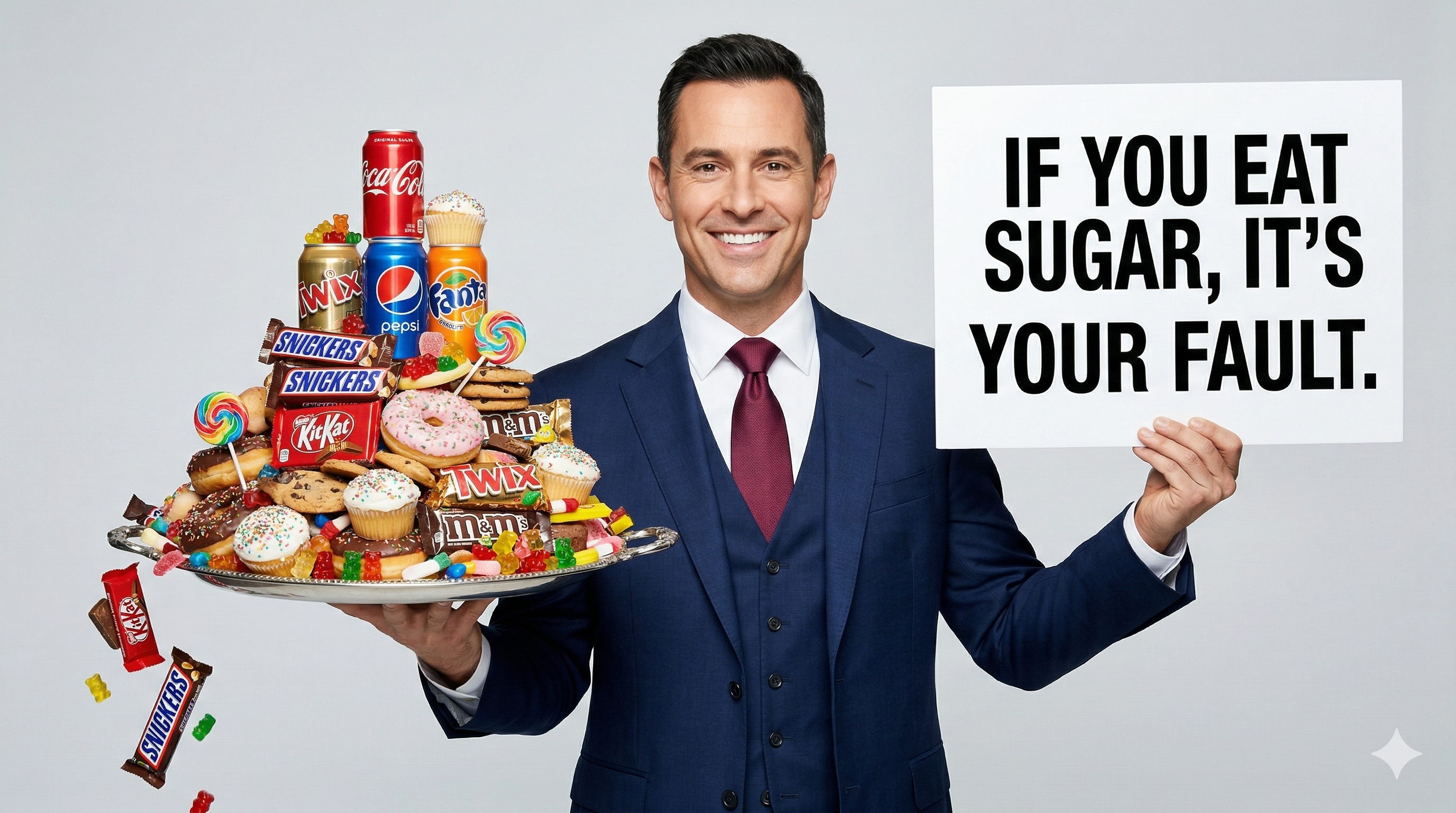
That distinction matters enormously. Policy interventions like soda taxes and warning labels demonstrably fail without an internal motivation shift. SSB tax substitution studies show consumers just switch to other sugary products. But knowing that dark nudges exist, knowing HOW the manipulation works, actually functions as empowerment rather than victimhood. The internal shift works precisely because it’s freely chosen, not guilt-driven. We’ll come back to what that shift actually looks like in Part 5. But first, there’s a biological layer underneath all the cultural engineering that most people have never heard of.
The Evolutionary Mismatch
Underneath the industry manipulation and the environmental design, something much older is happening inside your body. Emerging research from evolutionary biologists suggests that fructose gets metabolized in the liver by fructokinase, completely bypassing the normal glycolysis checkpoints that regulate glucose. That bypass causes rapid ATP depletion and a uric acid spike. The resulting lipid overload disrupts hepatic insulin receptor signaling, promoting uncontrolled gluconeogenesis even when insulin levels are already elevated.
Your body is simultaneously producing too much insulin and unable to respond to it, a metabolic contradiction that drives fat storage and constant hunger not because you’re weak, but because the hardware is running famine preparation software in a world of perpetual abundance.
In plain terms: fructose takes a shortcut through your liver that your body has no safety valve for. The result is fat buildup in your liver, insulin that stops working, and a hunger signal that never shuts off.
Every sip of soda is preparation for a winter that never comes. And that ancient mismatch is causing damage right now, in ways that standard medical checkups are not designed to catch. Which brings us to something most people have never considered: what if your blood work is lying to you?
PART 3: The Damage You Don’t See
The 7-Week Illusion
Imagine you go to the doctor, they run a metabolic panel, and the results come back normal. So you figure you’re fine. Maybe sugar isn’t that big a deal after all. Except that standard blood work is measuring the wrong things at the wrong time. A 2025 systematic review found that short-term sugar trials (7 hours to 49 days) showed no significant effects on fasting blood glucose, insulin, or triglycerides. Your doctor checks the metabolic panel and says you’re fine. But those same trials showed immediate significant increases in uric acid, total cholesterol, and LDL cholesterol. The reassurance of “normal” blood work is the illusion.
The timeline gets worse the closer you look. 80g per day of fructose or sucrose for 7 weeks causes massive liver fat synthesis increase while blood glucose and insulin resistance parameters remain completely normal. By the time standard metabolic panels catch it, the damage is advanced. And if you’re thinking “I’m not overweight, so this probably doesn’t apply to me,” the next section is specifically for you.
You Don’t Have to Be Overweight
If you’re lean, you might assume this section doesn’t apply to you. I’d keep reading. Roughly 1 in 5 normal-weight individuals have metabolic-associated steatotic liver disease (MASLD), and 19-25% of all MASLD patients are normal weight. Fructose drives Th17 pro-inflammatory cell generation through the mTORC1 pathway independent of obesity.
Research from Newcastle University explains why: every individual has a genetically determined tolerance for subcutaneous fat storage, what researchers call the Personal Fat Threshold. Exceed it, and metabolic dysfunction kicks in regardless of how you look on the outside. The Twin Cycle Hypothesis describes how liver fat spills over into the pancreas, choking beta cells and shutting down insulin production. But here’s the part that matters most: those beta cells are sleeping, not dead. Weight loss can wake them up. The damage is reversible if you catch it. But the liver and pancreas aren’t the only organs taking hits.
What’s Happening Upstairs
The liver and pancreas get most of the attention in sugar research. But the brain is taking hits too, and this is where the story connects directly to why the problem feels so hard to solve. Sugar compromises blood-brain barrier integrity, allowing peripheral inflammatory cytokines to activate microglia and trigger neuroinflammation. Advanced glycation end-products (AGEs) accumulate on neurons, driving the amyloid-beta and tau pathology associated with Alzheimer’s disease. Insulin resistance in the brain impairs glucose metabolism so severely that researchers have started calling Alzheimer’s “Type 3 diabetes”.
High-sugar diets downregulate hippocampal Brain-Derived Neurotrophic Factor (BDNF) expression, reducing neural plasticity and contributing to cognitive decline and depressive behaviors. And the darkest irony of all: sugar causes structural impairment and diminished function of the prefrontal cortex, which is the exact brain region you need for self-control and executive function. The substance compromises the hardware needed for the fix.
Which is why willpower was never going to be enough on its own. But the same biology that makes the damage fast also makes recovery fast.
Two Days to a Different Gut
Your gut microbiome begins measurably shifting within 48 hours of dietary change. Sugar-driven dysbiosis reduces neuroprotective short-chain fatty acids, increases intestinal permeability, and allows lipopolysaccharide (LPS) endotoxins to trigger systemic inflammation through the gut-brain axis. The speed of that process cuts both ways: the damage starts fast, but so does recovery.
Robert Lufkin MD , a medical professor I’ve had on the podcast twice, described his own experience after quitting sugar and going low-carb:
“When I was eating junk food and candy all the time... I’d eat an apple and it would taste like cardboard. But now... I bite into an apple and it’s like a symphony of flavors” (Ep. 63).
The palate literally recalibrates once the constant sugar bombardment stops.
That recovery points to something most sugar articles miss entirely, and it’s the part of this article I find most interesting: a genuine paradox buried in the research about what actually works.
PART 4: The Paradox
Why “Cutting Back” Makes It Worse
If you’ve ever tried to “just cut back” on sugar and found yourself thinking about it constantly, there’s a name for what happened to you. Andrew Hill’s 2007 research in the Proceedings of the Nutrition Society found that restricting a specific food while eating everything else normally triggers “ironic cognitive processes,” a rebound effect that INCREASES craving for the restricted food. Tell yourself you can’t have chocolate, and your brain starts running a background process that monitors for chocolate everywhere. The restriction becomes the fixation.

The pattern shows up in multiple studies. A rigid control mindset (all-or-nothing dieting) is associated with higher disinhibition, more frequent binge eating, and higher BMI. Rigid food rules and sudden abstinence trigger obsessive food thoughts, anxiety, and emotional distress, ultimately leading to relapse.
P&G learned this firsthand- with laundry detergent, not food, which makes the point even stronger. When they partnered with Rob Gronkowski to tell teenagers “Do not eat” Tide Pods, the result: poison control cases spiked, with 39 intentional teen ingestion cases in the first 15 days of 2018 alone, matching the total for all of 2016. If reactance can make people eat something that isn’t even food, imagine what it does when the restricted substance actually tastes good and your dopamine system is already primed for it.
When you tell yourself “I can’t have that,” your brain hears a challenge.
The Fasting Surprise
So restriction makes cravings worse. That seems like a dead end. Except that complete elimination is different from partial restriction, and the distinction changes everything. Hill’s same research found that short- and long-term fasting, or very-low-energy diets, lead to FEWER food craving experiences. And the reduction persists even during re-feeding. The cravings don’t rebound when food comes back.
This is the mechanism behind Lufkin’s apple experience from Part 3: once the bombardment stopped, his palate recalibrated because the conditioned response had nothing to latch onto. And the research backs that up: the craving reduction from elimination persists even when food is reintroduced. You eliminate sugar, the conditioned craving fades, and when you eventually have sugar again, the old craving cycle doesn’t reactivate. The reset holds.
The critical distinction: partial restriction keeps cues active. You still see sugar, smell sugar, taste sugar occasionally, and each exposure feeds the conditioned-cue reflex from Part 1. Complete elimination removes the cue entirely. The craving has nothing to latch onto. My own experience mirrors this. I went from needing a timed lockbox on the kitchen counter (seriously) to genuinely not wanting sugar. The lockbox phase was restriction. The shift to “I don’t want it” was something else entirely. But before I get to what that “something else” is, I need to address an obvious objection.
The Nuance That Changes Everything
If you’ve been reading carefully, you might have noticed a contradiction. I just said restriction backfires, and then I said elimination works. Those sound like the same thing. So how can one fail and the other succeed?
The answer isn’t about removing sugar from your environment. That’s impossible. Your coworker is still going to bring donuts. The grocery store isn’t going anywhere. The cues from Part 1 don’t disappear.
What changes is whether the loop completes. When you “cut back” but still eat sugar occasionally, each time you give in, you run the full cue-response cycle: see it, crave it, eat it, get the dopamine hit. The conditioning stays fresh. Worse, the unpredictability of when you’ll give in makes the craving more persistent, not less. Your brain stays on alert because it doesn’t know when the next reward is coming.
When you stop entirely, the cue still fires. You see the donuts, you feel the pull. But the loop never completes. No consumption, no dopamine hit, no reinforcement. Over time, that pull weakens because nothing happens at the end. That’s the mechanism behind Hill’s finding that fasting reduces cravings while cutting back increases them: it’s not about avoiding the cue, it’s about starving the loop.
There’s another layer. Robinson and Berridge’s 2025 work in the Annual Review of Psychology describes incentive sensitization: chronic sugar alters the brain to assign intense motivational “wanting” to food cues even as actual “liking” (the pleasure you get from eating it) decreases. You crave what you don’t even enjoy anymore. Once you see that the craving is a ghost, that you’re chasing pleasure that’s already gone, that awareness itself becomes therapeutic. If you want to explore the neuroscience of that “wanting vs liking” split and how it connects to the GLP-1 drug conversation, I wrote about it in detail in Food Noise: How a Patient Experience Became a Marketing Strategy.
PART 5: The Reframe
Mindset Literally Rewires the Reward System
So willpower depletes over time, restriction backfires through ironic cognitive processes, and elimination works- but only if it comes from the right place. What’s the “right place”? The research has an answer, and it’s not what most people expect.
Here’s the distinction that resolves everything from Part 4: what determines if elimination works isn’t whether you do it, but why. Rigid control — “I can’t have that,” “I’m not allowed” — is associated with higher disinhibition, more frequent binge eating, and higher BMI. But flexible control — a non-rigid approach driven by internal awareness rather than imposed rules — predicts significantly greater weight loss success, a finding supported by multiple studies. Same principle applies to elimination: when the decision comes from genuinely not wanting it anymore rather than enforcing a rule, the psychological frame changes completely — and so do the outcomes.
The mechanism is the one Robinson and Berridge identified: once you see that the craving is incentive sensitization- your brain assigning intense “wanting” to something you don’t even “like” anymore- that awareness itself becomes therapeutic. You stop white-knuckling against a craving and start recognizing it as a ghost signal from an outdated loop. The elimination holds because the identity behind it changed, not because you’re enforcing a rule.
You’ve Already Done This Before
Here’s what I keep seeing in my coaching practice that gives me genuine optimism about this. Everybody has an old version of themselves they’ve outgrown. Maybe it’s the person who used to smoke, or the person who never exercised, or the person who drank too much in their twenties. You look back at those habits now and they feel like they belonged to someone else. You didn’t white-knuckle your way out of all of them. At some point, the math just shifted: what you were gaining by changing started to outweigh what you were leaving behind, and the old behavior stopped making sense.
That’s the shift this article is pointing toward. It’s not about cataloging everything wrong with your sugar habits and trying to engineer your way out of them. In my coaching practice, the work is actually the opposite: we focus on your strengths, what you already do well, and build toward your own vision of wellness. The sugar stuff tends to resolve as a side effect of that larger shift. Once your mindset changes, once you genuinely see yourself as someone who’s moving in a different direction, the systems you need start assembling themselves. You don’t have to micromanage every cue and trigger from Part 1. You just have to get to the point where the old patterns feel like they belong to that other person.
If you want to see which pattern is running your sugar consumption right now, the quiz at idontwantsugar.com maps your craving patterns in about 3 minutes. No commitment, just clarity. It breaks down where you fall across four dimensions — Stress Response, Energy Patterns, Routine Triggers, and Reward Patterns — and each one has different leverage points.
Mindset beats systems, and systems beat willpower.
Stay healthy, stay awake.
On this newsletter, we question the conventional, explore the unconventional, and seek truth in health and wellness. If that resonates with you, please subscribe and tell others.
Below the paywall: a practical toolkit for applying what you just read. The elimination vs restriction framework, an invisible systems audit you can do tonight, the identity shift research, specific behavioral hacks backed by individual studies, and what recovery actually looks like based on the latest research. Tools, not more information.
Keep reading with a 7-day free trial
Subscribe to 'Healthy & Awake' Substack to keep reading this post and get 7 days of free access to the full post archives.